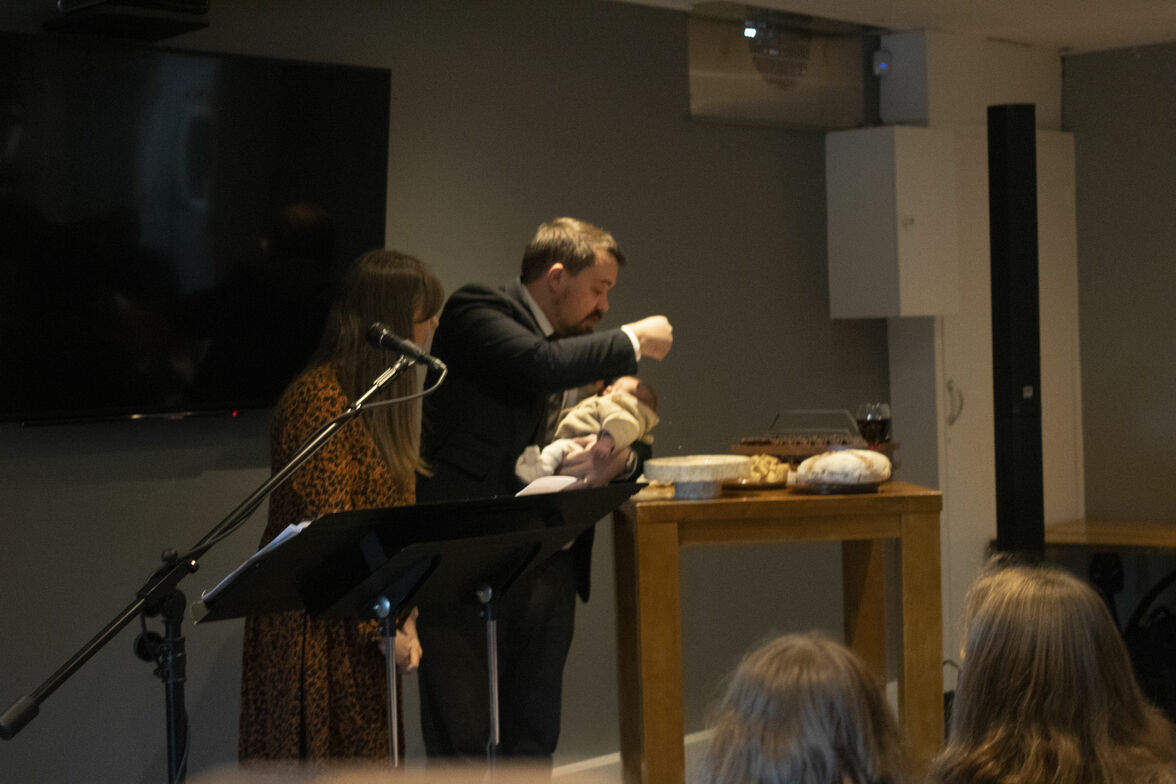
Baptism at Veritas Church
Infant Baptism
Infant baptism is not a sentimental add-on or a family tradition. It is a covenant act of God—a gospel sign that marks our children as belonging to the visible people of God, places the Triune name upon them, and summons them (and us) to a lifetime of faith, repentance, worship, and obedience.
This guide aims to:
- explain why we baptise infants,
- clarify what baptism means (and what it does not mean),
- outline what parents and the church are committing to,
- and set realistic, joyful expectations for life after baptism.
A Practical Theology of Infant Baptism
1) What is baptism?
Baptism is a sacrament of the New Covenant, instituted by Christ, in which water is applied in the name of the Father, Son, and Holy Spirit. It is a sign and seal of God’s covenant dealings with His people. Baptism is:
- a sign: God’s visible word portraying cleansing, union with Christ, and covenant membership.
- a seal: God’s pledge that His promises are real and trustworthy, calling for faith.
- a mark of belonging: entry into the visible covenant community (the church).
Baptism is not:
- magic or automatic salvation,
- a substitute for faith and repentance,
- a mere family dedication ceremony.
Baptism is God’s covenant claim and covenant promise applied in a tangible sign.
2) Why we baptise infants: the covenant logic
A) God ordinarily works covenantally, through households.
From Genesis onward, God’s redemptive work is not only individual; it is family-shaped and generational. He establishes His covenant with believers and their children, and gives covenant signs to mark that reality.
B) The New Covenant does not abrogate or diminish the household principle.
In the New Covenant, the gospel goes to all nations, and Christ’s kingdom expands. But the pattern “believer and their household” is not repealed. The question is not, “Do children belong to believers?”—that’s assumed throughout Scripture’s covenant life. The question is, “Has God explicitly removed children from covenant membership and its sign?” Our answer is: no.
C) The promise includes children—and summons them to faith.
When God claims a child in baptism, He does not say, “You don’t need faith.” He says, “You belong to Me—now live as My disciple.” Covenant inclusion is a gracious gift, and covenant life requires covenant response.
3) The biblical case (to summarise so far)
A) Continuity of covenant signs
- In the Old Covenant, the sign of covenant inclusion was given to infants.
- In the New Covenant, baptism functions as the initiatory covenant sign.
- The New Covenant sign is not narrower than the old (excluding children); it is broader (including nations).
B) Household principle in the New Testament
The New Testament repeatedly speaks in “household” categories, reflecting how covenant life worked socially and ecclesiastically. This supports, at minimum, that the apostles did not treat children as outsiders to the covenant people.
C) Jesus and the children
Our Lord receives children, blesses them, and identifies them as belonging to the kingdom in a way that undermines any casual “children are outsiders until they prove themselves” posture.
D) The burden-of-proof question
If the covenant sign formerly included infants, a reversal would require clear instruction. The New Testament contains no such prohibition—and the church’s covenant practice reflects that.
4) What infant baptism means in our church
When we baptise an infant, we are saying:
- God’s name is placed on this child. Baptism publicly marks the child as belonging to the Triune God, under His word and discipline, among His people.
- This child is received as a member of the visible church. Not merely “a visitor” or “a future prospect,” but one of us—under shepherding, prayers, and care.
- This child is called to a living faith. Baptism is a gospel sign that points to Christ. It does not replace conversion; it summons it.
- Parents are commissioned for covenant nurture. The sacrament strengthens and obligates parents to raise the child in Christ—expecting God’s ordinary blessing through ordinary means.
5) What about regeneration, assurance, and “baptismal efficacy”?
We affirm:
- God truly works through His appointed means (including baptism).
- Baptism is not empty; it is a real covenant act.
- The Spirit is sovereign and free; He is not bound to the moment of administration.
We therefore avoid two equal errors:
- presumption (“Baptised = saved, no need for discipleship”)
- minimalism (“Baptism is only a symbol, with no covenant reality”)
Instead we practice covenant realism: God’s promises are objective and true; the sign is meaningful; and covenant life must be met with faith, repentance, and perseverance.
6) Baptism and communion in our practice (paedocommunion)
Because we receive baptised covenant children as genuine members of the church, we also practice the early inclusion of children at the Lord’s Table.
What we believe we are doing
- The Supper is covenant meal communion with Christ and His body.
- Baptised children belong to the covenant people and should not be treated as outsiders to covenant worship.
- Participation is not a reward for intellectual maturity; it is a means of grace for the covenant community—including our children—under the nurture and oversight of parents and elders.
How this is practiced wisely
- Children come to the Table with parental guidance and under pastoral oversight.
- Parents are expected to teach reverence, explain the Supper simply, and correct casual or flippant habits.
- As children grow, we help them move from “receiving as children” to “self-conscious ownership”: confession of sin, discernment, eagerness for Christ, and mature participation.
7) Who should present a child for baptism?
Normally:
- At least one parent is a baptised believer and a member (or is actively transferring membership) in good standing.
- The family is committed to living under the ordinary means of grace in the life of the church.
Common pastoral scenarios:
- Only one parent is Christian: the believing parent may present the child, with the church’s support, while seeking peace and unity in the home.
- Parents are new or irregular: we may delay until there is clear commitment to worship and shepherding—not as punishment, but because baptism entails real vows.
8) What parents are promising
When you present your child for baptism, you are not only requesting a sacrament—you are making a public covenant commitment.
Parents promise, by God’s help:
- to raise the child as a Christian disciple, not neutrally,
- to teach the faith (Scripture, prayer, catechism, gospel basics),
- to model repentance and obedience,
- to keep the child under Christ’s shepherding through the church,
- to worship faithfully on the Lord’s Day,
- to pursue the child’s spiritual good in the home with patience and firmness.
A realistic summary:
You are promising direction, not perfection: a home oriented toward Christ, where sin is dealt with honestly and grace is lived and taught.
9) What the congregation is promising
Baptism is not “a family moment” alone; it is a church act. The congregation is committing:
- to receive the child as one of the flock,
- to pray for the child and the parents,
- to encourage the family, especially when parenting is hard,
- to provide examples worth imitating,
- to help the child grow in Christian life, not merely attend church.
A healthy culture says: “This child is ours, and we will love them toward Christ.”
10) What to expect practically (before, during, and after)
A) Before the baptism: the pastoral meeting
Expect a short meeting with an elder covering:
- the gospel and the meaning of baptism,
- your basic testimony and church commitment,
- your understanding of your vows,
- practical details of the service and congregational involvement.
You might be asked:
- Are you members (or pursuing membership)?
- Are you attending Lord’s Day worship consistently?
- Are there any pastoral issues needing care before taking vows publicly?
B) During the service: what happens
- Baptism is administered in the gathered worship as part of covenant renewal.
- Water is applied by sprinkling/pouring in the Triune name.
- The pastor addresses parents and congregation with vows.
- The church welcomes the child as a member of the visible covenant community.
- You will be welcomed to come to the front of the room to take your vows before the congregation.
- The head of the household will take vows on behalf of his household (her household in the case where there is no father/the father is not a Christian).
- You will be asked to hand your child to the minister who will administer the baptism. He will pray for the child and hand him or her back to you.
- You will be presented with a certificate signed by the elders of the church as proof of baptism and a gift Bible for your child.
C) Baptismal vows:
[Parents] have brought [Child] to be baptised. It is therefore essential that they believe in Christ and will bring [Child] up to do so too. I am therefore going to ask them to affirm their own faith in the words of the Apostles’ Creed, followed by some other questions regarding their faith.
I believe in God the Father Almighty, maker of heaven and earth. I believe in Jesus Christ, His only-begotten Son, our Lord; who was conceived by the Holy Spirit, born of the Virgin Mary; suffered under Pontius Pilate; was crucified, died, and was buried; He descended to the dead; the third day He rose again from the dead; He ascended into heaven, and sits at the right hand of God the Father Almighty; from there He shall come to judge the living and the dead. I believe in the Holy Spirit; the holy catholic church; the communion of saints; the forgiveness of sins; the resurrection of the body; and the life everlasting. Amen.
Do you believe that the death which baptism symbolises should by rights have been yours and [Child]’s, were it not for Christ’s death for you, taking the penalty for your sins? We do.
Do you believe that the washing from sin, new life, and outpouring of the Spirit which baptism symbolises come only through Christ’s death and resurrection? We do.
Do you therefore understand that people can only be saved through faith in Jesus Christ, and not through anything they can do? We do.
Do you renounce the world, the flesh, and the devil, and repent of your sins of thought, word, and deed against the living God? We do.
Do you trust in Christ alone for your salvation, and understand that [Child] must do so too, if [his/her] baptism is to be of any value to [him/her] ? We do.
Baptismal Promises
Do you therefore promise to bring [Child] up in the instruction, obedience and worship of the Lord, to pray for [him/her] and with [him/her], to include [him/her] in the fellowship of the church, and to be an example to [him/her] of faith and life? We do.
Will you teach [him/her] what [his/her] baptism means for [him/her], urge [him/her] to repent and believe continually in the Lord Jesus Christ, and assist [him/her] in every possible way to lead a life of devoted service to [his/her] Lord and Saviour? We will.
Congregational Promise
[Child] is to be baptised into the visible Church of Jesus Christ, and will become a member of this congregation. Therefore we who are members are all obliged to love and receive [him/her] as a fellow-member of Christ’s body, for ‘we were all baptised into one body’. Do you promise to encourage [Child] in [his/her] Christian life by godly example, prayer, exhortation and practical concern? We do.
The Baptism
[Child] has been born into the family of the church and will be brought up to know and love Jesus Christ. I am therefore delighted to baptise [him/her] today.
[Child], I baptise you in the name of the Father, the Son and the Holy Spirit.
FAQ
“Shouldn’t baptism follow personal faith?”
Adult converts should be baptised upon profession of faith. But children of believers are not treated as outsiders waiting at the gate. They are covenant members by God’s appointment, and baptism marks that covenant reality and calls them into lived faith.
“Where is infant baptism explicitly commanded?”
Many biblical doctrines are established by good and necessary consequence from Scripture’s covenant structure. The inclusion of children is a major biblical theme; a reversal would require explicit exclusion. We see continuity, not repeal.
“Does infant baptism guarantee salvation?”
No. Salvation is by grace through faith in Christ. Baptism is a covenant sign and seal that calls for faith and repentance, and God works through the means of covenant nurture.
“So do baptised children need conversion?”
They need Christ—truly and personally. The language may differ (“conversion” as dramatic moment vs. “coming to mature faith”), but the reality is the same: they must trust Christ and walk in repentance.
“What if my child later rejects the faith?”
We grieve, pray, pursue, and hope. Baptism is not a lie; it is God’s covenant claim, and covenant breakers are real. Yet God’s mercy is deep, and the church persists in loving pursuit.
“Are we allowed to baptise at home or privately?”
No. Baptism is a church sacrament, tied to public worship, covenant membership, and church oversight.
